Learning to drive is about much more than steering, braking and following road signs. For new drivers, knowing how to recognise hazards, judge distances and make safe decisions can make all the difference on the road.
If you’re learning in Officer or nearby South East Melbourne suburbs, these 10 practical safe driving tips will help you develop better driving habits, avoid common mistakes and prepare for your VicRoads driving test.
Whether you’re a complete beginner or already have some driving experience, understanding these essential safety principles will help you become a more confident and responsible driver.
- Learn how to recognise potential road hazards.
- Improve observation and blind spot checks.
- Maintain safe speeds and following distances.
- Build confidence in different traffic conditions.
- Prepare for your VicRoads driving test.
Why Safe Driving Matters for Learner Drivers
When you’re a beginner, even familiar roads can present unexpected challenges. A parked vehicle may pull out, a pedestrian may step onto a crossing, or traffic ahead may suddenly slow down. Learning to recognise these situations early gives you more time to respond safely.
Driving around Officer and neighbouring suburbs also means learning to handle different road environments. Residential streets, busy intersections, shopping areas, school zones and higher-speed roads all require careful observation and good decision-making.
The goal isn’t simply to pass your driving test. It’s to become a driver who can recognise potential dangers, make sensible decisions and protect everyone sharing the road.
10 Essential Safe Driving Tips for Beginners
1. Adjust Your Seat, Steering Wheel and Mirrors Before Moving
Never start driving before making sure you’re sitting comfortably and can see clearly. Adjust your seat so you can reach the pedals without stretching, keep a slight bend in your elbows and position your steering wheel comfortably.
Set your rear-view and side mirrors to minimise blind spots. You should be able to check your surroundings without constantly changing your driving position. Taking a moment to do these checks before every lesson helps establish a consistent safety routine.
2. Check Your Blind Spots Before Changing Direction
Your mirrors cannot show everything around your vehicle. A car, cyclist or motorcyclist may be travelling beside you without appearing in your mirrors. That’s why a quick head check is essential before changing lanes, merging, pulling away from the kerb or turning.
For example, when moving into another lane on a busy road near Officer, check your mirrors, indicate, perform a head check and only move when there is a safe gap. Never assume another road user will move out of your way.
3. Maintain a Safe Following Distance
Following too closely leaves you with less time to react when the vehicle ahead brakes suddenly. Use the three-second rule to maintain a safe gap in normal driving conditions.
Choose a fixed object beside the road. When the vehicle in front passes it, count three seconds. If your car reaches the same point before you finish counting, increase the distance.
Increase your following distance to at least four seconds at night, in rain or fog, in poor lighting, or whenever road conditions make it harder to stop safely. A greater gap gives you more time to react and reduces the risk of a rear-end collision.
4. Follow Speed Limits and Slow Down for Road Conditions
Speed limits are maximum legal speeds, not a target you must always reach. You may need to drive more slowly when visibility is poor, traffic is heavy, roads are wet or pedestrians are nearby.
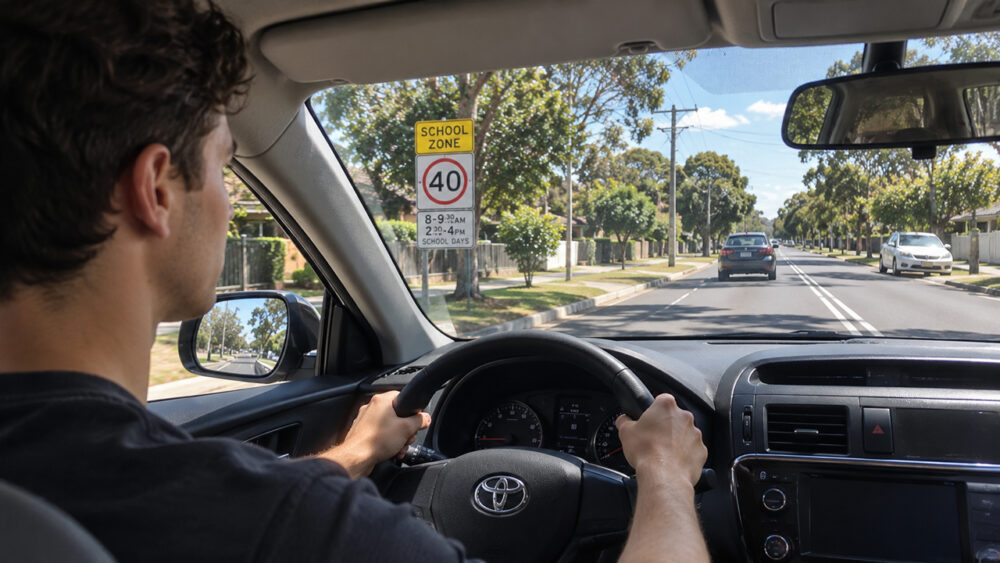
Pay particular attention to school speed zones around Officer and surrounding suburbs. School-zone limits and operating hours can vary, so always follow the speed signs displayed on the road rather than assuming every school zone has the same limit.
When approaching an intersection, pedestrian crossing or busy shopping area, ease off the accelerator and be prepared to stop if necessary.
5. Look Ahead and Identify Potential Hazards Early
Good drivers don’t focus only on the vehicle directly in front of them. Look further along the road while regularly checking your mirrors and surrounding traffic.
Watch for brake lights, changing traffic signals, pedestrians near crossings, cyclists, vehicles reversing out of driveways and cars approaching from side streets. Identifying hazards early gives you more time to slow down or adjust your position safely.
This habit is particularly useful when driving through residential streets and approaching busy intersections around Officer, Berwick and Pakenham.
6. Use Your Indicators Correctly and Give Other Drivers Warning
Indicators communicate your intentions to other road users. Use them when turning, changing lanes, entering or leaving a parking space, and whenever the road rules require you to signal.
Signal in good time to give other drivers enough warning, but don’t indicate so early that you confuse them about which street or driveway you intend to enter. Remember to check your mirrors and blind spots before moving, and cancel your indicator after completing the manoeuvre.
When approaching a roundabout, choose the correct lane and follow the road signs and lane markings. Give way to vehicles already in the roundabout and any tram entering or approaching it. Use your indicators according to the direction you intend to travel, and signal left when exiting where required.
7. Brake and Accelerate Smoothly
Sudden braking and acceleration can make driving uncomfortable and reduce your ability to control the vehicle smoothly. Look ahead, anticipate changes in traffic and begin slowing down early when approaching intersections, traffic lights or queues.
Apply the brakes progressively and accelerate gently when it is safe to move. Smooth control also helps you maintain better awareness of what’s happening around you.
8. Avoid Distractions and Stay Focused
Even a moment of distraction can cause you to miss an important road sign, pedestrian or change in traffic conditions.
As a learner driver in Victoria, you must not touch or operate a mobile phone or device while driving, including using voice controls. A securely mounted device may be used for permitted navigation or audio functions only if it is set up before your journey. You must not touch or adjust it while driving. Portable devices must not be used while driving, even if they were set up beforehand. Pull over and park safely before operating any device.
If you’re feeling anxious, tired or overwhelmed, don’t force yourself to continue driving. Find a safe place to stop when appropriate and take a break.
If driving makes you nervous, read our guide on managing driving test anxiety for practical advice on building confidence.
9. Adjust Your Driving to Rain, Darkness and Changing Conditions
Wet roads, reduced visibility and darkness can make driving more challenging, especially for beginners. In rainy conditions, slow down when necessary, increase your following distance and avoid sudden steering or braking movements.
You must use your headlights between sunset and sunrise and whenever hazardous conditions reduce visibility. Make sure you know how to operate your vehicle’s headlights and select the appropriate setting for the conditions.
At night, use your headlights correctly, watch carefully for pedestrians and animals, and avoid driving faster than your visibility and stopping distance allow.
If you’re still gaining experience, practise driving in these conditions with your supervising driver, starting with familiar routes and less challenging situations.
You can also explore our guide to your first driving lesson in Melbourne to understand how to build your skills step by step.
10. Practise Real Driving Situations Before Your VicRoads Test
Knowing the road rules is important, but you also need to apply them confidently in real traffic. Practise different road situations, including intersections, roundabouts, parking, lane changes, merging and responding to unexpected hazards.
A professional driving lesson can help identify habits that need improvement before your assessment. A mock driving test is also useful for experiencing test-style conditions and understanding where you need more practice.
Focus on consistent observation, safe decision-making, speed control and following road rules rather than simply memorising a test route.
For more information about safe driving practices, following distances, speed limits and road awareness, read the official Transport Victoria safe driving tips.
Practising Safe Driving Around Officer and Nearby Suburbs
One of the best ways to become a safer driver is to practise in different environments rather than relying on the same familiar streets. Around Officer and South East Melbourne, you can gradually develop your skills by experiencing different road conditions.
- Residential streets: Practise controlling your speed, checking for parked vehicles and watching for pedestrians or children.
- Busy intersections: Improve your observation, lane positioning and decision-making when approaching traffic lights and junctions.
- Roundabouts: Learn how to select the correct lane, give way and signal appropriately.
- Higher-speed roads: Develop confidence with speed management, safe following distances and merging where appropriate.
- School zones and shopping areas: Learn to anticipate pedestrians, cyclists, parked vehicles and changing speed limits.
If you’re learning in a nearby suburb, explore our local driving lesson pages:
Learn Safer Driving Skills with Start Driving School
Understanding safe driving principles is important, but developing these skills requires regular practice and guidance. At Start Driving School, we provide professional automatic driving lessons for beginners and learner drivers across Officer and surrounding South East Melbourne suburbs.
Our lessons focus on essential skills such as vehicle control, hazard awareness, mirror checks, safe lane changes, parking and handling different traffic situations. We help learners identify areas that need improvement and build their driving skills through practical on-road experience.
Whether you’re preparing for your first lesson or getting ready for your VicRoads driving test, structured instruction can help you become more aware, capable and confident behind the wheel.
- Professional automatic driving lessons.
- Practical instruction in a Toyota Corolla.
- Experience on local roads in South East Melbourne.
- Driving test preparation and mock tests.
- Flexible lesson times.
- Free home pick-up and drop-off in Officer and Pakenham.
Ready to Start Your Driving Journey?
Take the next step towards becoming a safer and more confident driver. Book an automatic driving lesson with Start Driving School and start developing the skills you need for everyday driving and your VicRoads assessment.
Call • SMS • WhatsApp
Start Driving School
Professional Automatic Driving Lessons in South East Melbourne