Need to complete your night driving hours? Learn what counts, how to record your hours, how to practise safely and how to build confidence driving after dark.
If you are learning to drive in Victoria, night driving is an important part of building real-world driving experience. For learners under 21 who are working towards their probationary licence, VicRoads currently requires at least 120 hours of supervised driving, including 20 hours of driving at night. Your driving experience must be correctly recorded before you can progress to your probationary licence.
The good news is that you do not need to complete your night hours all at once. With a sensible practice plan, you can gradually build confidence with darkness, headlights, wet roads, unfamiliar streets and busier traffic.
Quick Answer: How Many Night Driving Hours Do You Need?
If you are under 21 when applying for your probationary licence in Victoria, you need a minimum of 120 hours of supervised driving experience, including at least 20 hours at night. These hours need to be correctly recorded in your myLearners app or learner logbook.
For the latest official learner requirements, check the VicRoads guide to driving on your Ls.
What Counts as Night Driving?
Night driving is different from simply driving late in the afternoon. For learners using the myLearners app, night-time driving is calculated using the sunrise and sunset times for that day, so the app determines which part of your drive counts towards your night hours.
This means there is no single fixed clock time that applies every day. If you are trying to build your required night driving hours, check your recorded hours in myLearners rather than assuming that every drive after a particular time will count as night driving.
Rather than trying to complete your hours as quickly as possible, use each session to practise a specific skill and gradually expose yourself to different road conditions.
How to Complete Your Night Driving Hours
A simple way to approach your night driving practice is to increase the difficulty gradually.
- Start with familiar, quieter streets.
Begin where you already feel comfortable with steering, speed control, intersections and basic observation. - Practise around different levels of traffic.
Once you are comfortable, include roads with more vehicles, traffic lights, intersections and changing speed limits. - Practise dealing with headlights.
Learn how to manage glare from approaching vehicles without losing your lane position or reducing your attention to the road ahead. - Include wet conditions when appropriate.
Wet roads can change visibility and braking conditions, so supervised experience in different weather can be valuable. - Gradually introduce unfamiliar roads.
As your confidence improves, practise reading signs, following directions and making decisions in areas you do not know as well.
Why Night Driving Can Feel Difficult for Learners
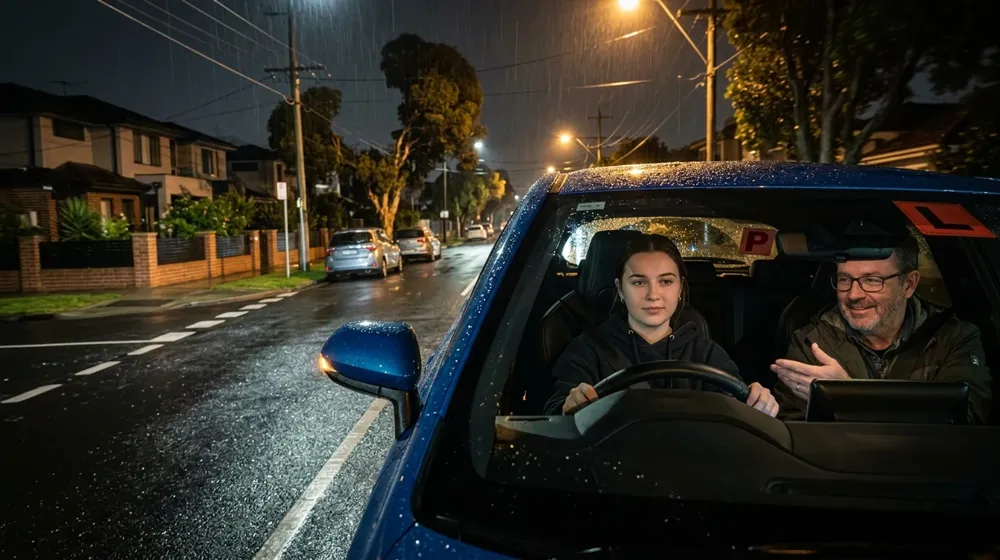
Many learners find night driving more demanding because there is less visual information available. Headlights from other vehicles, darker road edges, pedestrians, cyclists, parked cars and changing weather can all require additional attention.
- Headlight glare: Avoid staring directly into approaching headlights and maintain your attention on the road and your lane position.
- Reduced visibility: Scan further ahead and pay attention to road signs, intersections and changes in the road environment.
- Fatigue: Do not use night practice as an opportunity to drive when you are already tired.
- Wet roads: Allow more time to react and adjust your driving to the conditions.
- Loss of confidence: If darkness makes you nervous, start with shorter supervised sessions and increase the difficulty gradually.
Can a Parent or Family Member Supervise Your Night Driving?
Yes, provided the person supervising you meets the requirements for a supervising driver. Your required night driving does not have to be completed entirely with a professional driving instructor.
Professional lessons can complement family practice by giving you structured instruction on areas that may be difficult to practise or assess on your own, such as night-time observation, road positioning, dealing with glare and driving on unfamiliar roads.
A Practical Night Driving Practice Plan
Instead of trying to finish all your night driving hours as quickly as possible, spread your practice across your learner period. A balanced approach could look like this:
Stage 1 — Build confidence
Practise on familiar residential streets and focus on smooth steering, speed control, observation and lane positioning.
Stage 2 — Increase complexity
Add intersections, traffic lights, busier roads and more complex traffic situations.
Stage 3 — Practise real-world situations
Include unfamiliar roads, different traffic conditions and more challenging night-time environments as your confidence develops.
Night Driving Practice in South East Melbourne
If you are learning in South East Melbourne, regular practice in the areas you normally drive can help you become more comfortable with local roads and traffic conditions.
Start Driving School provides automatic driving lessons in areas including Officer, Pakenham, Berwick and Clyde.
If you are a nervous learner, you can also learn more about our driving lessons for nervous and anxious learners
.
Night Driving Lessons with Start Driving School
If you want extra support, professional night driving lessons can help you practise safely, build confidence and gain experience in real-world night driving conditions.
Learn more about our Night Driving Lessons in Melbourne and see how a professional instructor can help you practise different night driving situations.
Our night driving lesson is $75 for 60 minutes. Standard daytime lessons are $65, and our 5-lesson package is $300.
A professional night driving lesson can be useful if you are unsure how to practise after dark, lack confidence around headlights and busy roads, or want structured feedback from an experienced instructor.
Our night driving lessons are available in an automatic vehicle and are designed to complement your supervised driving practice rather than replace it.
Night Driving Lesson Price
| Night Driving Lesson – 60 minutes | $75 |
| Standard Driving Lesson – 60 minutes | $65 |
| 5-Driving Lesson | $300 |
Prices shown are subject to change. Please confirm the current price when booking.
Frequently Asked Questions About Night Driving Logbook Hours
How many night driving hours do I need in Victoria?
If you are under 21 when applying for your probationary licence, you need at least 120 hours of supervised driving experience, including 20 hours at night.
Can I complete my night driving hours with my parents?
Yes, provided your parent is an eligible supervising driver. Your required night driving does not have to be completed entirely with a professional driving instructor. Family-supervised practice and professional lessons can be used alongside each other.
Do I need a professional instructor for my night hours?
No. Professional lessons are not the only way to complete your required supervised driving hours. However, an instructor can provide structured feedback and help you work on specific night-driving skills.
How do I record my night driving hours?
Victorian learners can use the myLearners app to record and approve supervised driving hours. The app uses sunrise and sunset times to determine which part of a drive counts as night driving. You can also use the learner logbook if you prefer to record your hours manually.
What should I practise during a night driving lesson?
Useful areas include observation, road positioning, managing headlight glare, reading signs, judging intersections, adapting to wet conditions and gradually becoming comfortable on less familiar roads.
Need Help With Your Night Driving?
Build your confidence after dark with a structured automatic night driving lesson in South East Melbourne.